
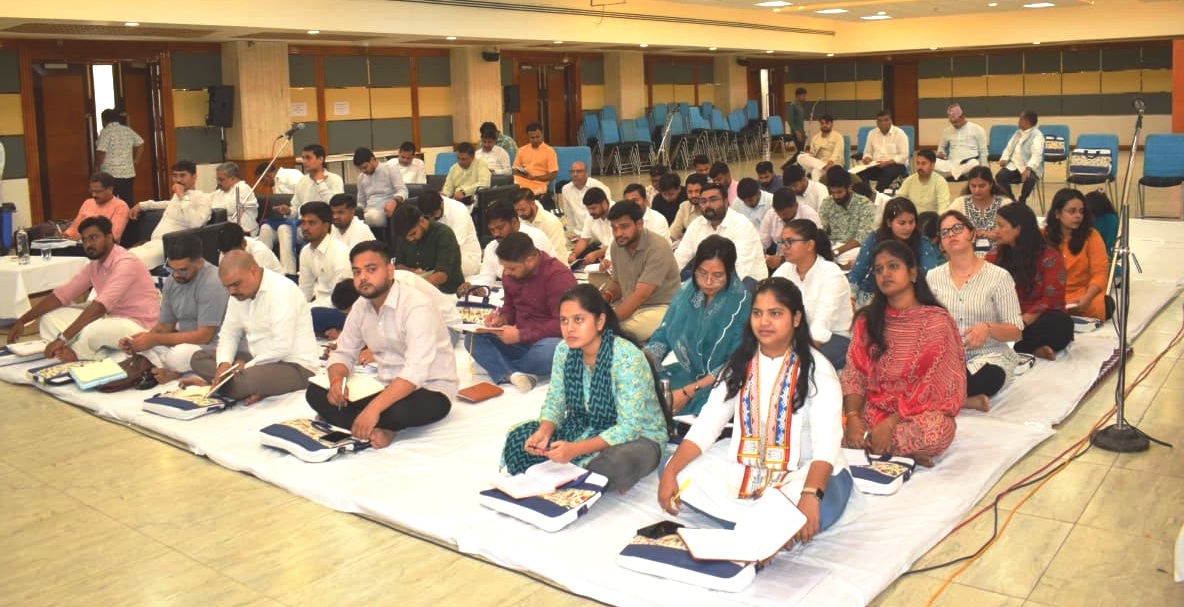
Bhubaneswar: A day-long central working committee meeting of Akhil Bharatiya Vidyarthi Parishad (ABVP) was organised at Siksha ‘O’ Anusandhan University here on Wednesday ahead of its National Executive Council (NEC) meet from 29 to 31 May, 2026.
ABVP national president Prof. Raghuraj Kishore Tiwari inaugurated the meeting in the presence of national general secretary Dr. Virendra Singh Solanki, and national organising secretary Ashish Chauhan.
A congratulatory resolution was passed appreciating the mandate of the people of West Bengal for ending the politics of violence, fear, and appeasement, and for re-establishing democratic values in the State. Extensive deliberations were held on the current national scenario, education system, role of youth, national security, social and economic issues, organisational review and expansion, and contemporary challenges. Discussions were also held on various ABVP initiatives including the ‘Screen Time to Activity Time’ campaign, 150 Years of Vande Mataram, Hostel Survey Campaign, Birth Centenary Year of Prof. Yeshwantrao Kelkar, 50 Years of Resistance to Emergency, 350 Years of the Martyrdom Day of Shri Guru Tegh Bahadur, and the 650th Prakatyotsav of Sant Shiromani Ravidas Ji.
Prof. Tiwari said, “To determine the future direction of the organisation, it is extremely important to review the previous years and assess the current circumstances; the Central Working Committee meeting holds immense significance in this process. The ‘Vichar baithak’ held in Dwarka and Sringeri were also part of this process and have proved to be milestones in strengthening the organisational framework in accordance with present-day requirements.
This year, on the occasion of the birth centenary of Prof. Yeshwantrao Kelkar Ji, awareness and intellectual programmes organised across the nation connected karyakartas with his ideals and working methodology, providing fresh inspiration that is highly relevant today. In the field of education, ABVP firmly believes that India’s education system should be rooted in Bharatiya philosophy and values, paving the way for an integrated educational framework that ensures the holistic and comprehensive development of the younger generation, he highlighted.
Speaking on the occasion, Dr. Solanki said, “At a time when Bharat is emerging as a global leader, ABVP continues to work through constructive movements and struggles to address challenges ranging from Urban Naxalism to discrepancies prevailing in the education sector.”
Whether it is the struggle for scholarships in Telangana, the issue of the NEET paper leak, the movement against paper leaks in Mumbai, or innovative initiatives through student unions in Delhi and Punjab Universities, ABVP has consistently worked in the interest of students. Tribal Student Conferences in Tripura, Chhatra Sansad in Odisha, Law Students’ Conference in Tamil Nadu, and providing self-defence training to more than one million girl students across the country under ‘Mission Sahasi’ are reflections of ABVP’s growing acceptance and expansion, he added.
Representatives from across the nation also deliberated upon contemporary issues related to education, society, economy, national security, global developments, and youth affairs. Resolutions on the subjects will be passed after detailed discussions in the National Executive Council Meeting. Karyakartas (executives) from all states across the nation were present in the meeting.
National Executive Council Meeting
The National Executive Council meeting of ABVP will be held from 29 to 31 May at Siksha ‘O’ Anusandhan University here. A total of 484 representatives from across the country will participate in the meeting, including ABVP national office bearers, student leaders from educational campuses across India, academicians, and representatives associated with various organisational dimensions and activities.
On 28 May, Chief Minister of Odisha Mohan Charan Majhi will attend the civic reception ceremony as the chief guest. Former and present ABVP karyakartas, eminent personalities from various walks of social life, academicians, and social leaders will participate in the programme.
During the three-day national executive council meeting, extensive deliberations will take place on the prevailing national scenario, education system, role of youth, national security, social and economic issues, organisational review and expansion, and contemporary challenges.